Most of us understand how important it is to protect our country’s streams and wetlands. These fragile environs are both home and nursery to many species of fish and wildlife. Considering the current popularity of off-road vehicles, it’s even more critical that sportsmen minimize their footprint when crossing streams on ATVs and Side-by-Side (SxS) utility vehicles.
If you’re riding on public lands with posted trails, the best thing is simply to stay on the trail and cross streams at the areas you are directed to. On private land, you should design trails and routes to keep stream crossings to a minimum. At frequent crossing points, you can provide the ultimate protection for streams by building a wooden bridge. Bridges eliminate altering the flow or disturbing the streambed, and they prevent bank erosion. The following are some recommended steps for building an ATV and/or SxS worthy water crossing:
- CHOOSE THE RIGHT LOCATION: To reduce the length of the bridge, the alignment should be at right angles to the stream and should not be located near abrupt bends in the channel. Locate the bridge on stable banks near a narrow section of the stream.
- CONSIDER WATER CAPACITY: The bridge must be constructed so it can easily span the stream during flood stages without causing any backwater effects upstream or increased flow velocity downstream. Also, bridges that are too small for the amount of water flow anticipated will likely be washed away. Bridge abutments must be set back at least 2 feet from the normal edge of the stream to prevent constriction during high flow conditions.
- SUPPLIES: Two or three sufficiently large logs of equal diameter (stripped of bark), rough sawn 6-foot 2x6 planks, (7-foot lengths to accommodate a SxS), two logs for end-sills, four shorter stake logs, and nails. Avoid using wood treated with creosote.
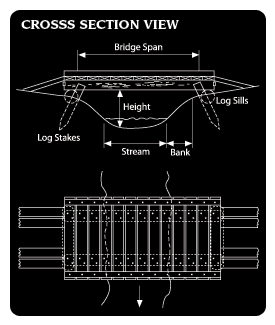
- CONSTRUCTION: Take care to prevent the disturbance of channel banks, vegetation and land within the high water zone of the stream. Don’t do any work when the stream is in flood. The basic design (see diagrams) has the two logs laid on a flat rock or a log sill at each end. Boards are nailed across the logs (if you are using 7-foot boards, a third log in the middle may be necessary). Approach ramps can be made out of a few short boards or the gap can be filled in with rocks. Pin the bridge in place with stakes. This will keep it from sliding off the sills and will help prevent it from washing away in the event of a flood. For more detailed information on ATV bridge construction, please click here.
QUICK TIP: When fording streams without a bridge, choose a shallow, rocky area with sloping banks on each side and slowly motor across. Avoid kicking up silt and stay away from wetlands and floodplain areas.

The Yamaha OHV Access Initiative is a proactive, grassroots program supported by Yamaha dealers and customers nationwide promoting safe, responsible riding and sustainable, open riding areas.
Through the OHV Access Initiative, Yamaha Motor Corp., U.S.A., is providing GRANTs to deserving organizations to help further the program’s goal of Guaranteeing Responsible Access to our Nations Trails.
Most recently OHV Access Initiative GRANTs have been given to two bridge building projects, one taking place in Dinwiddie County, Virginia, and the other in Itasca County, Minnesota. The goal of both projects is to create a safe way for ATV riders to gain access to additional trails without disturbing the waterways that bisect the lands.
- The Dinwiddie County bridge project is being managed by the Ride Safe Virginia group and upon completion will provide access to approximately 50 additional acres of dedicated riding terrain that are currently inaccessible to ATV enthusiasts.
- With the construction of the bridge in Itasca County the Balsam Trail Blazers organization will be opening up access to about 16 miles of ATV trails. Another goal of this project is to help in the effort to have the trails in this area officially recognized by the state of Minnesota as ATV terrain.
Both projects are currently in the planning and design phases and will begin construction this summer.
To learn more about the Yamaha OHV Access Initiative, please visit www.yamaha-motor.com/ohvaccess, call the dedicated hotline at 877-OHV-TRAIL (877-648-8724), or e-mail OHVAccess@yamaha-motor.com.
Safety Tip: Always wear appropriate riding gear when operating an ATV or SxS vehicle, which includes a helmet, eye protection, gloves, long sleeves, long pants and over-the-ankle boots.
Yamaha is proud to sponsor